RICS Whole Life Carbon Assessment: Central London Commercial Office Refurbishment
2026
Project Overview
Service: RICS Whole Life Carbon Assessment (WLCA) & GLA Policy Integration
Asset Class: Central London Commercial Office
Key Frameworks: RICS Professional Statement (2nd Edition), GLA Whole Life-Cycle Carbon Guidance, UKGBC Net Zero Carbon Buildings Framework
HollenPlus was appointed to deliver a comprehensive RICS Whole Life Carbon Assessment (WLCA) for a prime Central London office decarbonisation scheme. Grounded in our commercial asset management perspective, our role was to quantify, model, and reduce both embodied and operational emissions while safeguarding capital expenditure and long-term commercial returns.
Asset Summary & Refurbishment Strategy
The project objectives focused on extending the asset's operational lifespan, achieving market-leading ESG credentials, and maximising rental yields. HollenPlus navigated the core tension of commercial office refurbishments: balancing the retention of existing structural fabric against the necessity of replacing inefficient, outdated mechanical and electrical (M&E) services.
Balancing Embodied vs. Operational Carbon
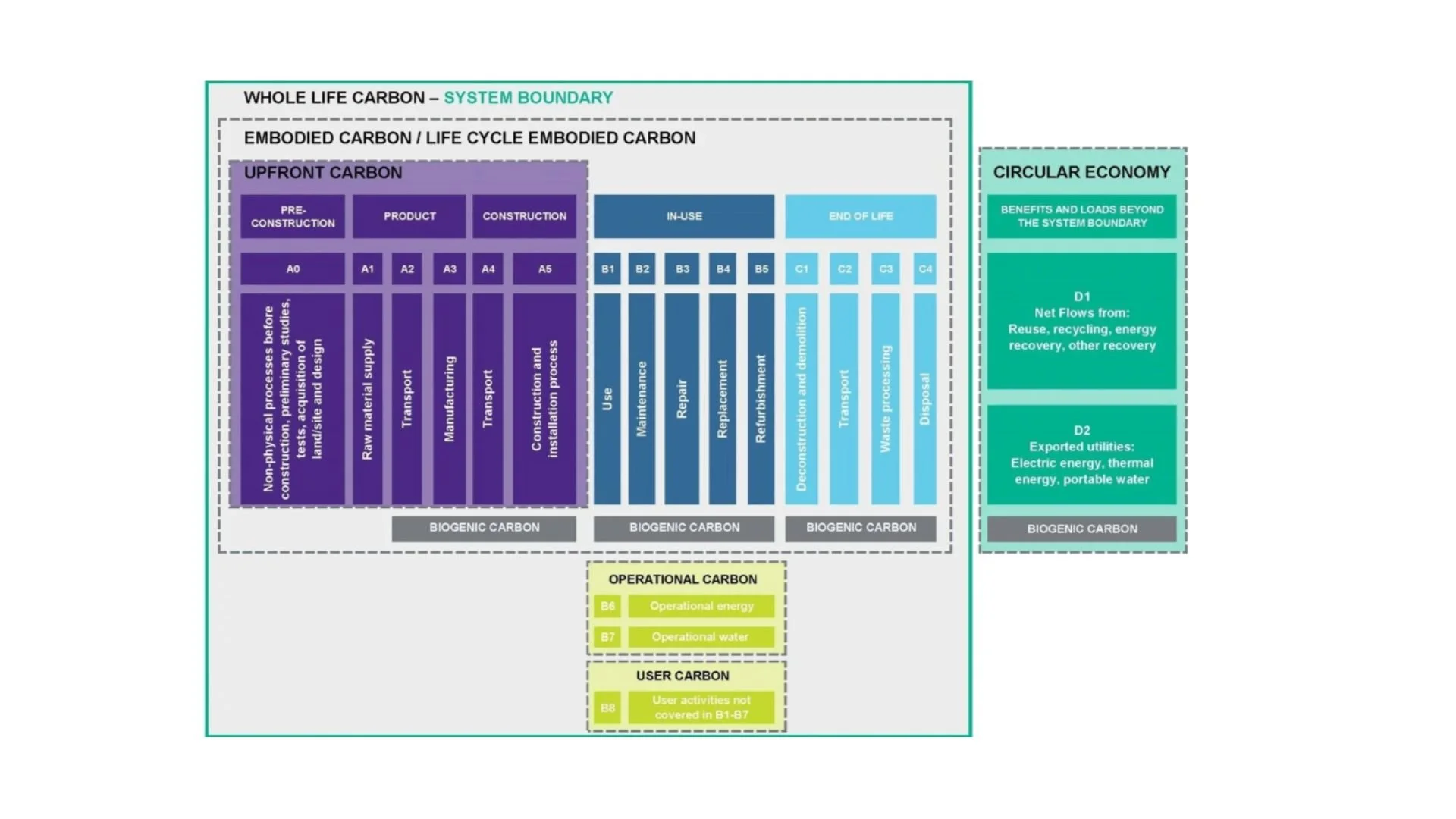
Achieving optimal lifecycle carbon reduction required dynamic trade-off modelling between upfront material carbon (Modules A1–A5) and in-use operational energy (Modules B6–B7):
Structural Preservation: Retaining the concrete superstructure and main envelope avoided significant upfront embodied carbon penalties typical of complete redevelopments.
M&E Systems Optimisation: Replacing legacy HVAC plant with high-efficiency heat pump systems unlocked substantial operational carbon reductions over the building’s hold period.
Carbon Payback Analysis: Every proposed material intervention was evaluated through a carbon payback model to ensure upfront carbon investments delivered a net reduction over a 60-year lifecycle.
RICS Methodology & GLA Planning Alignment
RICS WLCA Compliance: Standardised dynamic modelling across Module A (Product & Construction), Module B (In-Use & Operational Energy), Module C (End of Life), and Module D (Benefits Beyond Boundary).
GLA Policy SI 2 Integration: Aligned the carbon assessment directly with Greater London Authority (GLA) Whole Life-Cycle Carbon Guidance requirements for major London planning applications.
Iterative Baseline Benchmarking: Established early-stage carbon baselines across RIBA Stages 1–4 to measure and verify carbon reductions across each design revision.
Strategic Commercial Outcomes & Asset Value
Early-stage WLCA integration provided actionable procurement guidance, delivering tangible commercial and environmental value:
Targeted Material Selection: Guided the specification of low-carbon, circular materials, including reused raised access flooring, low-VOC timber finishes, and high-recycled-content insulation.
Institutional Tenant Attraction: Secured market-leading sustainability credentials, driving prime rental values and appealing to corporate occupiers with strict scope 3 reporting requirements.
Future-Proofed Valuation: Delivered a fully defensible Whole Life Carbon profile that protects the asset against stranded asset risk, tightening MEES regulations, and CRREM decarbonisation pathways.