ASHRAE Energy & Water Audits: Level 1, 2 & 3
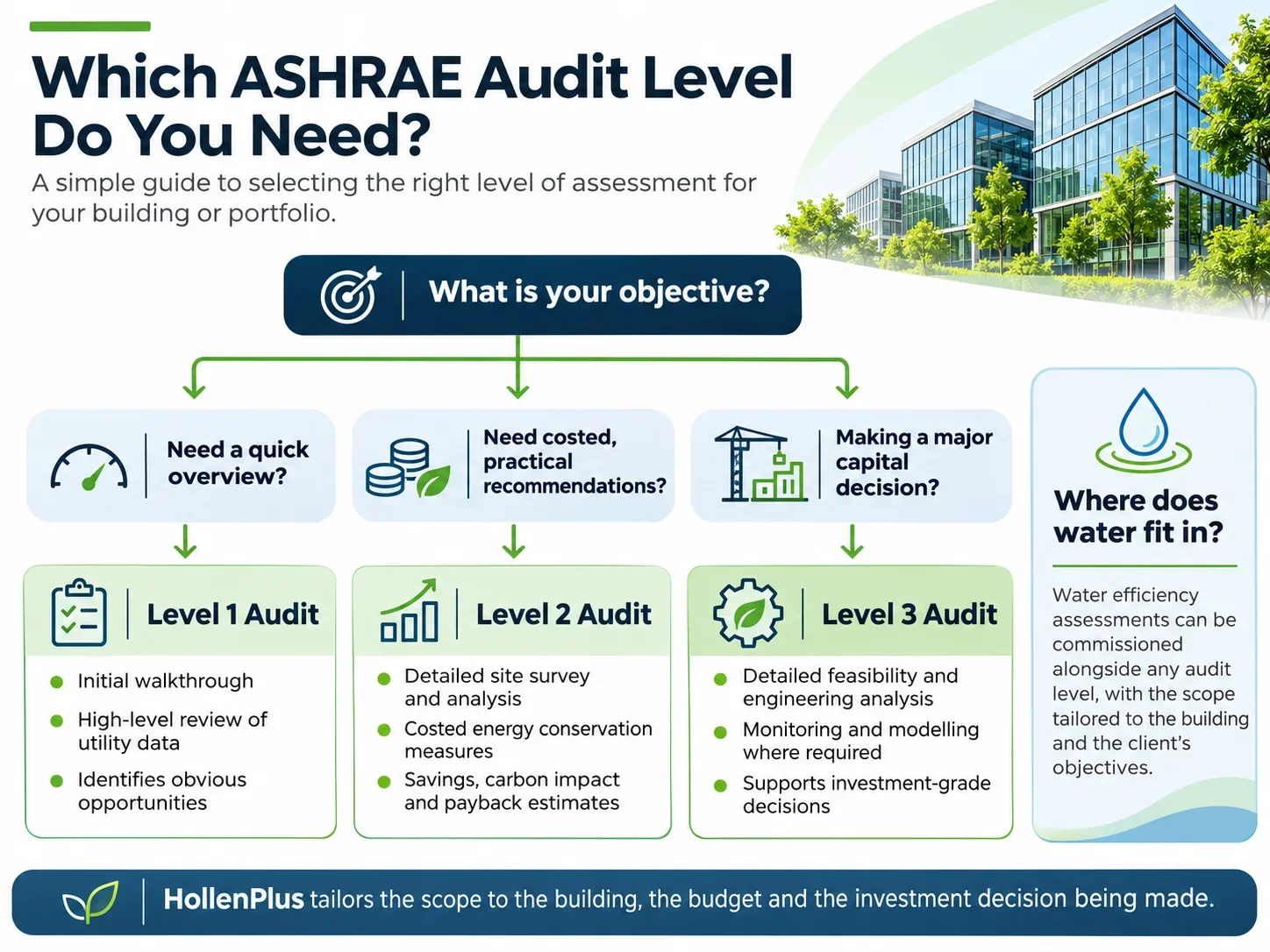
ASHRAE Energy & Water Audits: Levels 1, 2 & 3
Commercial Building Energy Audits | ASHRAE Standard 211 | UK & Europe
HollenPlus provides specialist ASHRAE energy audit services and commercial building water efficiency assessments for property investors, asset managers, landlords and corporate occupiers across London, the UK and Europe.
Our services cover the full spectrum of ASHRAE commercial building energy audits, including Level 1 walkthrough assessments, Level 2 engineering energy audits and Level 3 detailed investment assessments, alongside preliminary energy benchmarking and complementary water audits.
Combining technical energy assessment expertise with over 15 years of commercial real estate asset management experience, we identify opportunities to reduce energy and water consumption, lower operating expenditure, improve asset performance and support long-term decarbonisation.
Whether assessing a single commercial building, undertaking acquisition due diligence or developing a portfolio-wide energy efficiency strategy, we tailor our approach to the client's objectives, investment requirements and budget.
Our focus is straightforward: practical energy and water efficiency improvements, financially viable investment recommendations and measurable building performance benefits.
Request an ASHRAE Audit Proposal
What is an ASHRAE Energy Audit?
An ASHRAE energy audit is a structured technical assessment of a building's energy consumption, operational performance and opportunities for improving efficiency.
ASHRAE, the American Society of Heating, Refrigerating and Air-Conditioning Engineers, provides internationally recognised guidance for evaluating commercial building energy performance.
The auditing methodology examines how energy is consumed, identifies inefficient systems and operational practices, and evaluates measures that could reduce energy costs and carbon emissions.
Audits can range from a preliminary review of utility consumption to detailed engineering investigations supporting significant capital investment decisions.
An ASHRAE energy audit typically considers:
Historical building energy consumption and costs.
Heating, ventilation and air conditioning systems.
Lighting, electrical installations and associated controls.
Building fabric and thermal performance.
Building Management Systems and operating schedules.
Energy efficiency improvements and operational optimisation.
Opportunities for renewable energy and electrification.
Potential energy savings, carbon reductions and capital costs.
The resulting report provides an evidence-based foundation for improving operational efficiency, prioritising investment and developing a practical building improvement strategy.
ASHRAE Standard 211: Commercial Building Energy Audits
ANSI/ASHRAE/ACCA Standard 211, Standard for Commercial Building Energy Audits, establishes a consistent framework for undertaking and reporting commercial building energy audits.
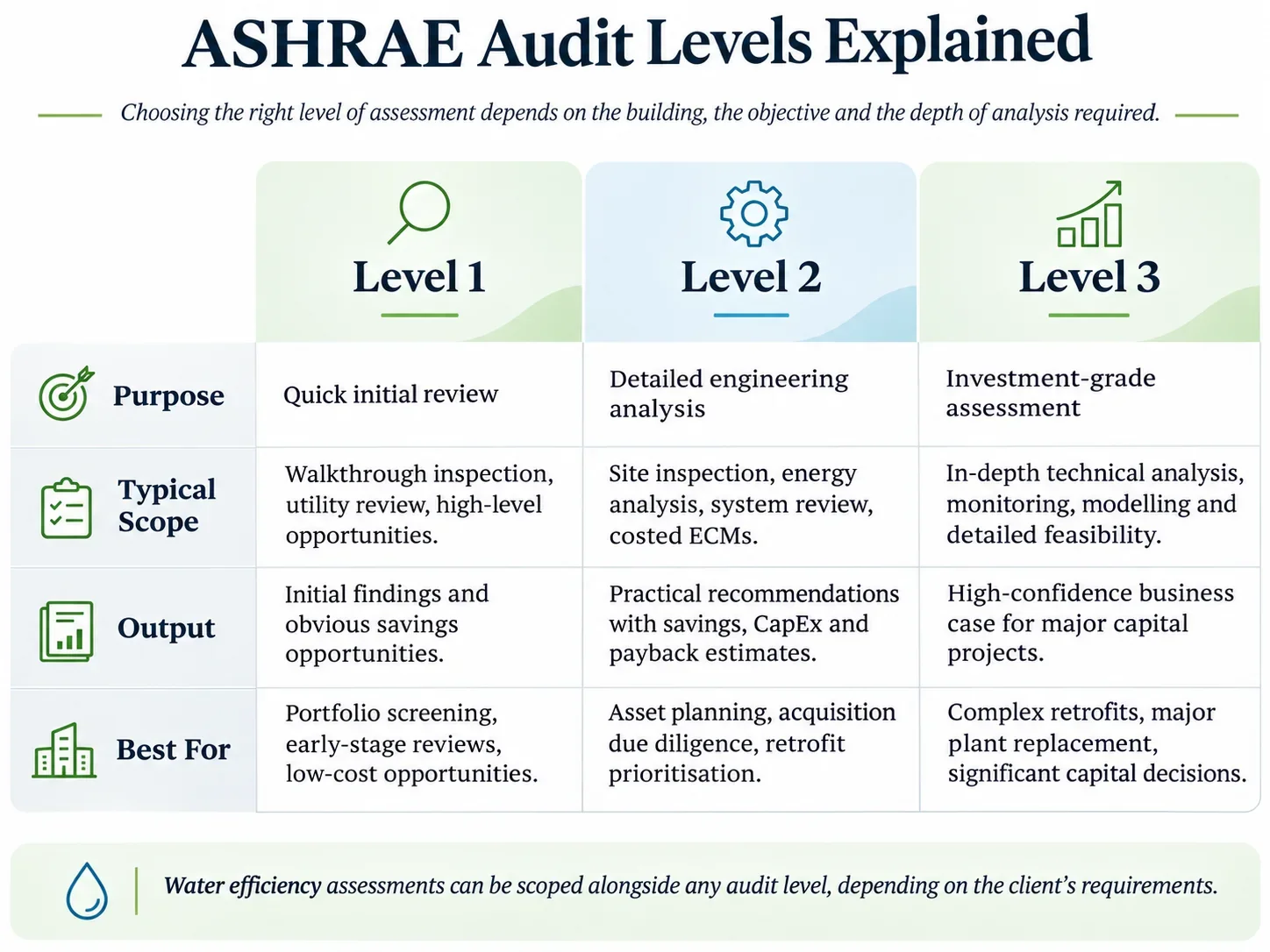
The standard defines three principal audit levels:
Level 1: Walkthrough Survey.
Level 2: Energy Survey and Engineering Analysis.
Level 3: Detailed Analysis of Capital-Intensive Modifications.
Each level builds upon the previous assessment, providing progressively more detailed analysis and increasing confidence in potential investment decisions.
The framework also incorporates preliminary energy use analysis, including utility consumption reviews and performance benchmarking.
HollenPlus can help clients establish the appropriate audit scope and coordinate the qualified technical resources needed where formal ASHRAE Standard 211 compliance is required.
ASHRAE Level 1 Energy Audit: Walkthrough Assessment
An ASHRAE Level 1 energy audit provides an initial review of a building's energy performance to identify obvious inefficiencies, operational improvements and opportunities for further investigation.
The assessment combines preliminary energy consumption analysis with a walkthrough inspection of the building and its principal energy-consuming systems.
What Does a Level 1 Audit Include?
A typical assessment includes:
Review of available utility bills and historical energy consumption.
Preliminary energy performance benchmarking.
Building walkthrough and visual inspection.
Review of major heating, cooling and ventilation systems.
Initial assessment of lighting and operational controls.
Discussions with building management and maintenance personnel.
Identification of potential energy conservation measures.
Indicative cost and savings estimates for appropriate measures.
Recommendations for further investigation where required.
When Is a Level 1 Audit Appropriate?
Level 1 assessments are particularly suitable for investors or property managers seeking an initial understanding of an asset's energy performance.
Typical applications include:
Portfolio-wide energy performance screening.
Initial assessment of newly acquired properties.
Early-stage asset management business planning.
Identification of low-cost operational improvements.
Prioritisation of buildings for more detailed investigations.
A Level 1 audit provides a practical starting point for understanding a building's energy performance without immediately committing to the more extensive analysis associated with Level 2 or Level 3 assessments.
ASHRAE Level 2 Energy Audit: Energy Survey and Engineering Analysis
An ASHRAE Level 2 energy audit provides a detailed technical and financial assessment of commercial building energy performance.
Building upon Level 1 analysis, it involves a more comprehensive review of building services, operational energy consumption and potential energy conservation measures.
The objective is to identify technically feasible improvements and provide costed recommendations that can inform asset management decisions, capital expenditure planning and retrofit investment programmes.
What Does a Level 2 Audit Include?
Depending on the building and scope, a Level 2 energy audit includes:
Detailed analysis of utility consumption and energy costs.
Building energy benchmarking and end-use assessment.
Site inspection and technical review of building services.
Evaluation of heating and cooling plant performance.
Assessment of ventilation, lighting and electrical systems.
Review of BMS controls, operating schedules and setpoints.
Identification and evaluation of practical energy-saving measures.
Engineering calculations estimating potential energy savings.
Preliminary capital expenditure and implementation costs.
Financial evaluation, including estimated annual savings and payback.
Assessment of carbon emissions reductions.
Prioritised recommendations and implementation opportunities.
When Is a Level 2 Audit Appropriate?
A Level 2 audit is particularly valuable where building owners require sufficiently detailed information to make informed decisions about energy efficiency investments.
Typical applications include:
Commercial property acquisition due diligence.
Asset management and business plan development.
Energy cost reduction programmes.
Commercial refurbishment and retrofit planning.
Decarbonisation feasibility assessments.
ESG investment strategies and portfolio improvement programmes.
Evaluating energy conservation measures before committing capital.
For many commercial buildings, Level 2 provides an effective balance between technical detail, assessment cost and commercially actionable recommendations.
ASHRAE Level 3 Energy Audit: Detailed Investment Analysis
An ASHRAE Level 3 energy audit provides a more detailed engineering and financial assessment of significant energy efficiency and capital improvement projects.
It builds upon earlier audit findings and concentrates on measures requiring greater investigation before substantial capital expenditure is approved.
Level 3 investigations may incorporate detailed equipment analysis, additional monitoring, calibrated energy modelling and more comprehensive financial feasibility assessments.
What Does a Level 3 Audit Include?
The scope may include:
Detailed engineering analysis of selected energy conservation measures.
Additional site surveys and technical investigations.
Equipment performance testing and monitoring where necessary.
Detailed building energy modelling and scenario analysis.
Evaluation of complex HVAC replacement or electrification options.
Detailed capital expenditure and lifecycle cost assessment.
Energy savings forecasts with defined assumptions and uncertainties.
Sensitivity analysis and financial investment appraisal.
Assessment of implementation constraints and operational disruption.
Detailed recommendations to inform project development and procurement.
When Is a Level 3 Audit Appropriate?
Level 3 assessments are particularly suitable for:
Major commercial building retrofit projects.
Significant plant replacement programmes.
Large-scale heating and cooling system upgrades.
Heat pump and building electrification investments.
Complex energy conservation projects.
Major institutional capital expenditure decisions.
Projects requiring detailed engineering evidence before investment approval.
A Level 3 audit helps reduce uncertainty associated with major energy efficiency investments, providing a more developed technical and financial business case.
Preliminary Energy Use Analysis and Building Energy Benchmarking
Before determining the appropriate audit level, an initial assessment of building energy performance can establish whether more detailed investigation is justified.
Preliminary energy use analysis examines historical utility consumption, energy costs and available building information.
An important metric is Energy Use Intensity (EUI), commonly expressed in kWh/m²/year, which helps compare energy consumption between buildings of different sizes.
Analysis may include:
Annual electricity, gas and district energy consumption.
Energy expenditure and consumption trends.
Comparison against relevant property benchmarks.
Weather, occupancy and operational factors.
Identification of unusually high or inefficient energy use.
Preliminary assessment of energy-saving potential.
Preliminary energy use analysis is part of the ASHRAE Standard 211 Level 1 process, rather than a separate formal audit level under that standard.
For property investors, benchmarking can help identify underperforming buildings within a portfolio and prioritise further assessments.
Commercial Building Water Audits and Water Efficiency Assessments
Alongside energy audits, HollenPlus can coordinate commercial building water audits and water efficiency assessments to identify opportunities to reduce consumption, control utility expenditure and improve resource efficiency.
ASHRAE's guidance on energy and water management recognises that similar levels of investigation can be applied to water consumption. Water audits are separately scoped, however, rather than being certified under the energy audit requirements of Standard 211.
What Does a Commercial Water Audit Include?
Depending on the building and required level of detail, water assessments may include:
Historical water consumption and billing analysis.
Water meter and submeter reviews.
Water consumption benchmarking.
Assessment of sanitary fixtures, taps, WCs and showers.
Review of domestic hot water systems and circulation losses.
Investigation of leaks, abnormal consumption and uncontrolled water use.
Cooling tower water consumption, where applicable.
Assessment of irrigation and external water demand.
Review of water management controls and operating practices.
Opportunities for improved metering and monitoring.
Evaluation of water-saving equipment and technologies.
Estimated capital costs, potential savings and financial payback.
Different Levels of Water Audit
Preliminary Water Assessment
An initial review of bills, consumption patterns and available information to identify potential inefficiencies and establish whether further investigation is appropriate.
Level 1-Style Water Audit
A walkthrough assessment of principal water-consuming systems, identifying visible inefficiencies, potential leaks and straightforward conservation opportunities.
Level 2-Style Water Audit
A more detailed review of water systems and consumption, with analysis of practical water conservation measures, implementation costs and potential financial savings.
Level 3-Style Water Audit
Detailed investigation of significant water improvement projects, including additional monitoring, technical feasibility and financial evaluation where required.
These descriptions refer to the depth of water audit investigation and not to separate formal certification levels under ASHRAE Standard 211.
Why Combine Energy and Water Audits?
Energy and water consumption are frequently interconnected.
Reducing hot water demand can lower both water costs and the energy required for heating. Cooling system optimisation may also affect electricity and water consumption.
A coordinated assessment helps identify these relationships, allowing investors and building managers to consider the total operational and financial impact of proposed improvements.
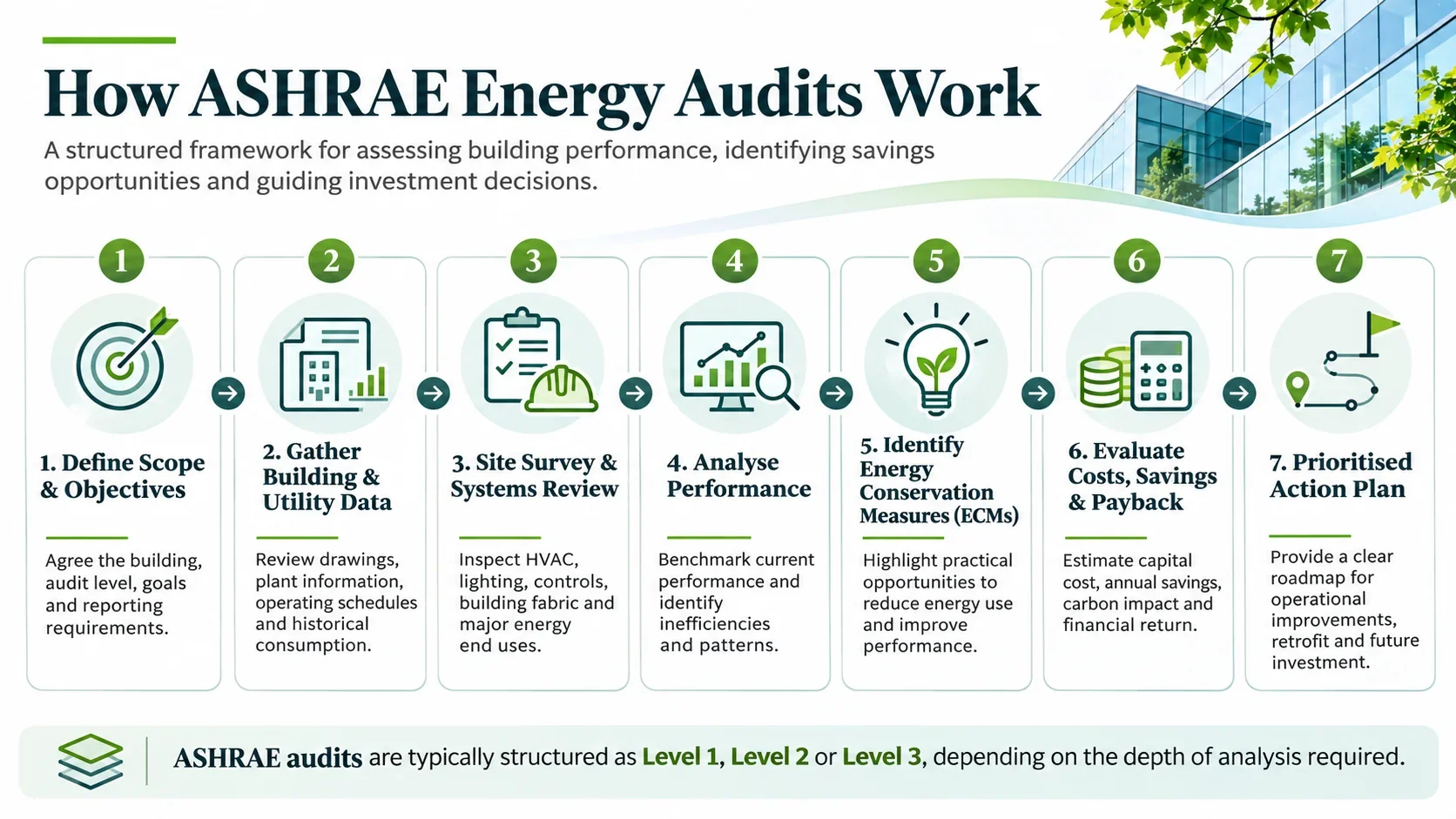
How Does an ASHRAE Energy and Water Audit Work?
Our assessment process is structured around the requirements of the building and the intended investment decision.
1. Define the Audit Scope
We establish the client's objectives, reporting requirements, building characteristics and appropriate level of investigation.
2. Collect Building and Utility Data
Available drawings, plant information, maintenance records, energy bills, water consumption data, operating schedules and metering information are reviewed.
3. Undertake the Building Survey
The relevant technical team inspects the building and assesses its principal energy and water-consuming systems.
4. Analyse Building Performance
Consumption data, system efficiency, operating conditions and potential inefficiencies are evaluated against appropriate benchmarks and engineering assumptions.
5. Identify Improvement Opportunities
Practical energy conservation measures and water efficiency improvements are identified, taking account of building constraints and operational requirements.
6. Evaluate Financial and Environmental Benefits
Where relevant to the audit level, recommended measures are assessed for implementation costs, operating savings, carbon impact, financial return and potential interactions.
7. Produce the Audit Report
The findings are presented in a structured report, highlighting material risks, improvement opportunities, financial considerations and recommended next steps.
Our objective is to turn technical building performance data into practical decisions that support investment returns and long-term asset improvement.
ASHRAE Energy Audits for Property Acquisition Due Diligence
Energy and water performance can have a material impact on commercial property operating costs, future capital expenditure and investment returns.
For prospective purchasers, inefficient building services, ageing equipment, high consumption and future decarbonisation requirements may represent significant financial liabilities.
HollenPlus brings a commercial asset management perspective to energy auditing, helping investors evaluate building performance within the context of acquisition underwriting and future asset business plans.
Our assessments can help identify:
Inefficient or ageing building services.
High or abnormal energy and water consumption.
Potential operational expenditure reductions.
Future capital expenditure requirements.
Opportunities for targeted refurbishment or retrofit.
Energy-related operational and investment risks.
Measures capable of improving building competitiveness.
Potential implications for decarbonisation and ESG strategies.
Assessments Tailored to the Transaction
We recognise that acquisition due diligence is frequently undertaken within challenging timescales and tightly controlled professional fee budgets.
Our approach is to understand the decision the client needs to make and ensure that the level of investigation is proportionate.
Where appropriate, we can provide targeted technical energy due diligence focused on material risks and investment considerations, reserving more detailed engineering assessments for matters that justify further investigation.
Where a formal ASHRAE Level 1, 2 or 3 audit is required, the agreed scope and delivery team must satisfy the applicable requirements of Standard 211.
We believe the purpose of an assessment is to improve investment decision-making, not simply to produce a lengthy technical report.
ASHRAE Energy Audits for Commercial Property Portfolios
For institutional investors and asset managers, portfolio-wide energy and water assessments can identify opportunities to reduce operational expenditure and prioritise investment across multiple assets.
HollenPlus can coordinate assessments at individual property level or develop a consistent approach for portfolios covering different building types, locations and levels of operational performance.
A portfolio-wide programme may include:
Initial consumption benchmarking across all properties.
Identification of high-energy and high-water-consuming assets.
Level 1 audits to screen improvement opportunities.
Level 2 audits for buildings requiring detailed recommendations.
Level 3 assessments for selected major investment projects.
Consistent technical and financial reporting.
Prioritised improvement programmes and capital expenditure planning.
Monitoring and review of implemented measures.
This staged approach helps concentrate detailed technical resources where they can deliver the greatest value.
Energy Conservation Measures, Capex and Financial Returns
The identification of practical energy conservation measures is central to an effective building energy audit.
However, not every technically feasible improvement represents an attractive investment.
HollenPlus applies commercial real estate expertise to evaluate recommendations against financial performance, implementation risks and the client's business plan.
Depending on the scope and audit level, financial appraisal can include:
Estimated capital expenditure.
Annual energy and water cost savings.
Simple payback periods.
Lifecycle costs and equipment replacement considerations.
Net present value (NPV).
Internal rate of return (IRR).
Carbon emissions reductions.
Operational disruption and implementation constraints.
Potential interaction between recommended measures.
Our approach prioritises operational optimisation and cost-effective interventions before recommending major capital replacement where these alternatives can meet the client's objectives.
The best recommendation is not necessarily the most expensive or technically ambitious. It is the intervention that delivers the strongest practical benefit within the client's investment constraints.
ASHRAE Energy Audits, Retrofit and Decarbonisation
An ASHRAE audit can provide an important starting point for developing a comprehensive building retrofit and decarbonisation strategy.
Understanding actual operational energy consumption and identifying inefficient systems helps establish where investment may deliver the greatest improvements.
Depending on the building and objectives, subsequent investigations may cover:
Heating and cooling electrification.
Air source and water source heat pumps.
Building fabric improvement strategies.
Building services optimisation.
Renewable energy generation.
Solar PV and battery storage feasibility.
Operational carbon emissions reduction.
Dynamic thermal simulation and energy modelling.
Phased retrofit investment programmes.
HollenPlus can integrate audit findings with wider commercial energy efficiency, net zero carbon consultancy and asset management strategies.
ASHRAE Energy Audits in the UK and Europe
ASHRAE methodologies are internationally recognised and may be specified by investors, lenders, multinational occupiers and property managers operating across multiple jurisdictions.
HollenPlus provides a UK-based point of contact for coordinating ASHRAE energy audit requirements across London, the wider UK and European commercial property markets, subject to appropriate project-specific technical resources and local requirements.
For UK and European buildings, the appropriate scope may also need to consider:
BS EN 16247 energy audit methodologies.
ISO 50002 energy auditing principles.
UK Energy Savings Opportunity Scheme (ESOS) requirements.
Local building energy performance regulations.
Relevant energy performance benchmarking standards.
Investor or lender-specific reporting requirements.
ASHRAE audits do not automatically replace national regulatory assessments or compliance obligations.
Where required, we can discuss how different audit and reporting requirements may be coordinated to reduce duplication and improve the value of the overall assessment.
What Is Included in an ASHRAE Energy Audit Report?
The content of the report depends upon the audit level and agreed technical scope.
Typical reporting elements may include:
Executive summary and principal findings.
Description of the building and operational systems.
Audit objectives and methodology.
Historical energy and, where commissioned, water consumption.
Energy Use Intensity and performance benchmarking.
Findings from building inspections and technical assessments.
Analysis of significant energy end uses.
Identified operational inefficiencies.
Recommended energy conservation measures.
Water conservation measures, where included.
Engineering calculations and supporting assumptions.
Estimated energy and water savings.
Financial appraisal and estimated implementation costs.
Potential carbon emissions reductions.
Identified limitations, uncertainties and further investigations.
Prioritised recommendations and implementation considerations.
Formal ASHRAE Standard 211 reports must include the applicable requirements for the specified audit level, including the required involvement and documentation of the Qualified Energy Auditor.
How Much Does an ASHRAE Energy Audit Cost?
The cost of an ASHRAE energy audit depends on the building, the level of investigation and the reporting requirements.
Principal considerations include:
Building size and complexity.
Required audit level.
Number and complexity of building services systems.
Availability and quality of utility data.
Site location and access arrangements.
Number of properties within the instruction.
Requirement for additional metering, monitoring or modelling.
Inclusion of water efficiency assessments.
Financial reporting and investment appraisal requirements.
Formal compliance and specialist auditor requirements.
HollenPlus takes a flexible, commercially proportionate approach to scoping and pricing.
For acquisition due diligence, a targeted assessment may offer a more appropriate starting point than a comprehensive engineering investigation, provided that it meets the client's actual reporting requirements.
For major investment projects or formal ASHRAE Level 3 assessments, a more detailed technical scope will be appropriate.
We tailor our proposals to deliver the level of analysis required, avoiding unnecessary expenditure while providing the information needed for informed decisions.
Why Choose HollenPlus for ASHRAE Energy and Water Audits?
Commercial Real Estate Expertise
HollenPlus combines chartered surveying and commercial property asset management experience with specialist energy and sustainability consultancy.
Our approach considers not only how buildings perform technically, but also how improvement measures affect operating costs, capital expenditure and investment returns.
Technical Energy Assessment Capabilities
Our existing technical capabilities include advanced energy modelling, commercial Energy Performance Certificates, building services assessment, energy efficiency strategies and retrofit feasibility.
For formally compliant ASHRAE audits, we establish the applicable Qualified Energy Auditor and specialist delivery arrangements as part of the agreed instruction.
Practical, Cost-Effective Recommendations
We prioritise improvements that are technically achievable, commercially justifiable and aligned with the client's investment objectives.
Asset and Portfolio-Level Solutions
We work with property owners, investors and occupiers on both individual buildings and wider portfolios, ensuring that energy performance findings are translated into practical asset improvement strategies.
Flexible Scope and Commercial Understanding
We recognise that a prospective purchaser assessing acquisition risks has different requirements from an asset owner planning a major retrofit.
Our approach reflects those differences, matching the assessment to the decision being made while maintaining the requirements of any specified audit standard.
FAQs
-
ASHRAE defines Level 1, Level 2 and Level 3 commercial building energy audits. Level 1 provides an initial walkthrough assessment, Level 2 offers detailed engineering analysis and costed recommendations, and Level 3 investigates significant capital investment measures in greater detail.
-
A Level 1 audit focuses on initial building performance assessment and identification of potential improvements. A Level 2 audit involves more detailed technical analysis, evaluation of energy conservation measures and financial estimates to support investment decisions.
-
Level 3 audits are generally appropriate when detailed engineering and financial analysis is needed to support major capital expenditure decisions, such as significant HVAC replacement, complex retrofit projects or large energy efficiency investments.
-
Preliminary energy use analysis reviews historical utility consumption, energy costs and building performance benchmarks. Under Standard 211, this is incorporated into the Level 1 audit process rather than constituting a separate formal audit level.
-
ASHRAE provides guidance on energy and water use management, including applying different levels of audit investigation to water systems. However, Standard 211 is specifically a commercial building energy audit standard. Water assessments require a separately defined methodology and scope.
-
An EPC assesses a building's energy performance under standardised calculation conditions. An ASHRAE audit investigates actual operational energy consumption, building systems and practical opportunities to reduce energy use and operating costs.
-
Yes. ASHRAE audit methodologies can be used internationally and may be specified by property investors, multinational occupiers and asset managers. UK and European properties may also be subject to separate national energy audit or regulatory requirements.
-
No. ESOS is a UK regulatory energy assessment scheme for qualifying organisations. ASHRAE Standard 211 is a technical framework for auditing commercial buildings. Although relevant information may overlap, completing an ASHRAE audit does not automatically establish ESOS compliance.
-
Formal compliance with ASHRAE Standard 211 requires the involvement of a Qualified Energy Auditor who fulfils the standard's competency and delivery requirements. Other technical specialists may support the assessment under the appropriate supervision.
-
The timescale depends on the audit level, building complexity, access arrangements and availability of technical information. Initial walkthrough assessments are generally less involved than Level 2 investigations, while Level 3 audits may require additional monitoring and engineering analysis.
-
Yes. Energy audits can be accompanied by a separately scoped water efficiency assessment. Combined reporting can identify energy and water savings, estimated implementation costs, financial benefits and improvement priorities.
-
Yes. They can help prospective purchasers identify inefficient building systems, operational costs, potential capital liabilities and improvement opportunities. The audit level should reflect the transaction requirements and the degree of technical certainty needed.
Request an ASHRAE Energy & Water Audit Proposal
Whether you require a preliminary building energy assessment, an ASHRAE Level 1 walkthrough audit, a Level 2 engineering analysis, a Level 3 investment assessment or a combined energy and water audit, HollenPlus can discuss an appropriate scope for your commercial property.
We work with property investors, landlords, asset managers and occupiers seeking practical, financially informed strategies to improve energy and water performance.
Contact HollenPlus to discuss your building, audit requirements and investment objectives.






Speak to a Partner today to enquire about an ASHRAE Energy & Water Audit Proposal…