
The Step-by-Step Guide to Commercial EPCs: From Survey to Certification l HollenPlus
A detailed guide on the process for undertaking a commercial EPC assessment.
The Step-by-Step Guide to Commercial EPCs
If you are selling, leasing, or constructing a business premises in the UK, a Commercial Energy Performance Certificate (EPC) is a legal requirement. With the government targeting a minimum Rating of ‘B’ by 2030, understanding the assessment process is vital for future-proofing your property assets.
HollenPlus provides comprehensive EPC advisory services, across level 3, 4 and 5 EPC’s, providing expert advice and guidance throughout the process. Our detailed knowledge of commercial real estate allows us to make informed recommendations, from commercial knowledge and lived experience.
1. Appointment & Pre-Assessment
The process begins by appointing a qualified Non-Domestic Energy Assessor (NDEA). For complex buildings (Level 5), this requires a specialist trained in Dynamic Simulation Modelling (DSM) such as HollenPlus.
Data Gathering: To speed up the process and improve accuracy, where possible, owners should provide floor plans, O&M manuals, and specifications for HVAC (Heating, Ventilation, and Air Conditioning) systems.
2. On-Site Energy Survey
A physical inspection is mandatory to record details of current:
Building Fabric: The assessor records construction details, insulation types, and glazing specifications.
Mechanical Services: Evaluation of boilers, chillers, heat pumps, and hot water systems.
Lighting & Controls: A significant factor in commercial ratings. The assessor notes the type of bulbs (LED vs. Fluorescent) and the presence of sensors or PIR controls.
Size, Layout & Zones: The assessor reviews and records the building size through accurate measurement, as well as layout configuration to "zone" the property based on usage (e.g., separating office space from storage or retail).
3. Data Modelling & Calculation
Back at the office, the assessor inputs the site data into government-approved software (usually SBEM for Levels 3–4 or DSM for Level 5).
At HollenPlus we go the extra mile, spending time researching specifications of every aspect of the building, to ensure that the most accurate inputs are used, which in turn, produces the most accurate EPC, with the best possible rating.
The Digital Twin: The software creates a 3D model of the building’s energy flow.
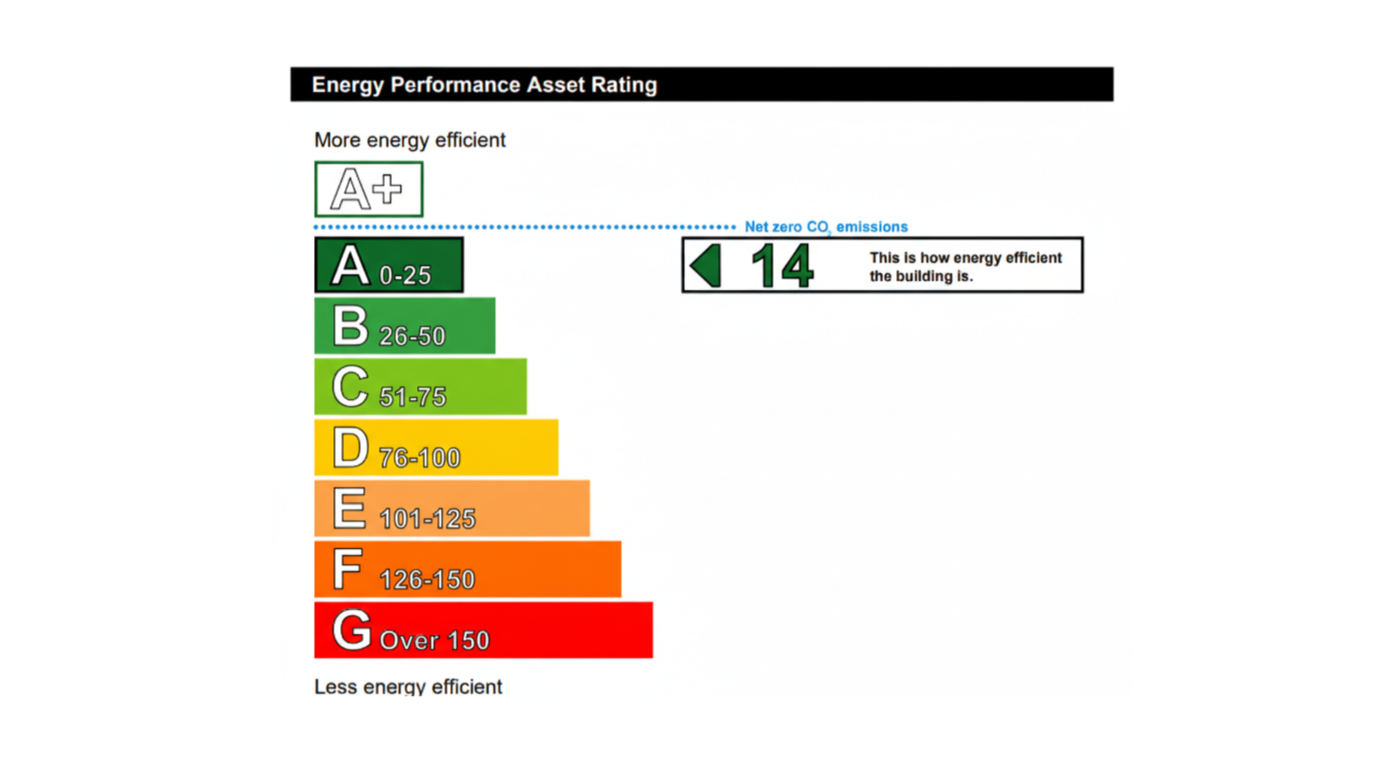
Benchmark Comparison: The building's performance is compared against a "notional" building of the same size and use to determine its final grade from A+ to G.
4. EPC Pathway Report
At HollenPlus, we transform the findings from Stages 1, 2 and 3 into a clear, tailored EPC pathway for each building. Starting with the baseline EPC, we undertake detailed energy modelling to assess the impact of the most commercially sensible upgrade opportunities.
Using our sector expertise, we identify and layer potential improvement measures onto the baseline EPC to evaluate their performance, cost, and overall benefit to the asset. These options are then presented in a concise yet detailed report, clearly setting out projected EPC improvements alongside associated capital costs.
Our additional modelling provides clients with the clarity and confidence required to make informed investment decisions. Crucially, our advice goes beyond energy performance alone. We factor in key commercial asset management considerations, including lease events, planned preventative maintenance (PPM), refurbishment programmes, and wider lifecycle planning.
The result is pragmatic, commercially focused advice designed to help each building achieve its target EPC rating at the lowest possible cost, with minimal disruption to occupiers and operations.
5. Lodgement & Recommendation Report
Once the calculation is complete, we arrange a meeting with our client to discuss the draft EPC and explore any next steps that we recommend prior to lodging the EPC.
If the assessment has produced an EPC rating below the clients target, we will make detailed, tailored recommendations with ideas that can be implemented prior to lodging the EPC, to secure a better rating.
Following finalisation of this process, and once the client has confirmed they are happy for the final EPC to be lodged, HollenPlus lodges the EPC onto the official UK Government Register.
The Certificate: You receive a PDF showing your current energy rating.
The Recommendation Report: This provides the opportunity for the EPC assessor to provide high-level advice on the measures available to improve the EPC rating, and is therefore an important part of the process. It is however, rigid in its nature and does not allow detailed advice to be conveyed to the client. This is where our expertise in the field becomes invaluable with the concise yet detailed EPC pathway report.
Why the Process Matters for Landlords
With the next EPC hurdle fast approaching, landlords need to ensure they have a clear action plan in place to achieve MEES compliance.
Our strategic advice and detailed pathways ensure our clients have a clear action plan in place for all of their assets, enabling them to maintain and increase property values and avoid significant fines for non-compliance.
For assets requiring upgrades, we work alongside our clients to create annual CAPEX actions and budgets, which are factored into the asset business plans.