Whole Life Carbon Assessment (WLCA) Services in London
At HollenPlus, we provide comprehensive Whole Life Carbon Assessments (WLCA) in London and across the UK designed specifically to de-risk property portfolios, eliminate the threat of stranded assets, and give asset managers the verifiable data needed to satisfy stringent ESG criteria.
Why is a Whole Life Carbon Assessment Essential?
For modern property portfolios, a Whole Life Carbon Assessment (WLCA) is no longer a voluntary sustainability badge; it is a critical instrument for financial risk mitigation and regulatory compliance. As the built environment shifts toward net-zero targets, understanding the complete carbon impact of your real estate assets is essential for preserving capital value and securing market liquidity.
Understanding the Whole Life Carbon across the Building Lifecycle
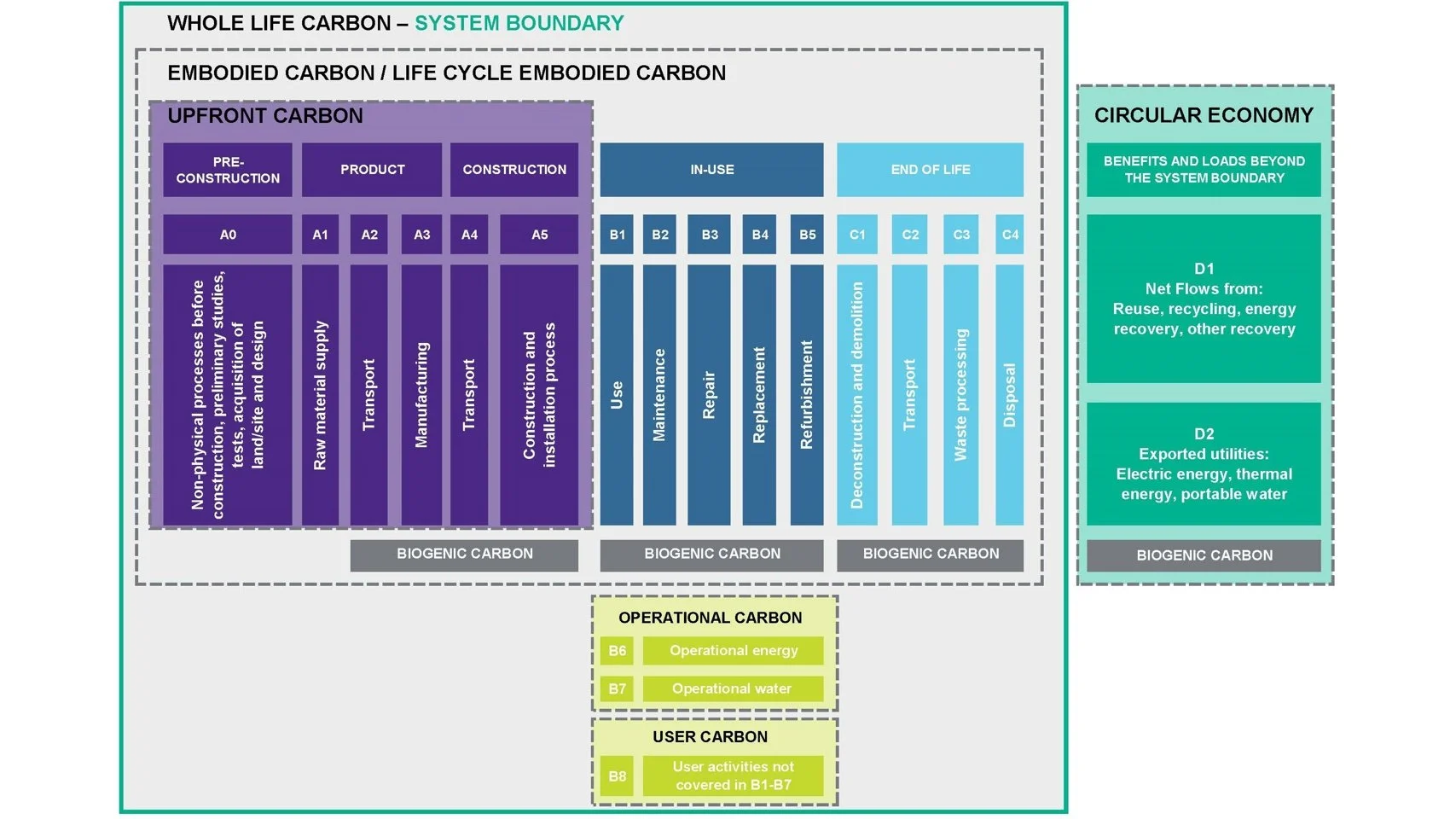
Buildings and infrastructure require substantial quantities of materials, energy and resources throughout their lifecycle, making the built environment sector a significant contributor to global greenhouse gas emissions. Throughout all the different stages within the lifecycle modules, carbon emissions not only arise from the operation of the building; such as heating, cooling, ventilation, lighting and equipment use, but carbon also needs to be accounted for throughout all the lifecycle stages. From the very start of the process from the extraction of raw materials and product manufacturing, all the way through to transportation, construction activities, maintenance, refurbishment, replacement and the end-of-life process.
The HollenPlus Approach to WLCA in London
At HollenPlus, we use the One Click LCA Platform, the world’s largest lifecycle assessment Platform to undertake a Whole Life Carbon Assessment to determine the carbon footprint of your asset. It incorporates a comprehensive database of verified Environmental Product Declaration (EPDs) together with recognised generic datasets for construction materials, mechanical electrical equipment and building products. Where required, supplementary emissions factors can be obtained from recognised databases such as the Inventory of Carbon and Energy (ICE) Database, including other nationally representative datasets available within the One Click LCA Platform.
Governing Standards & Lifecycle Frameworks
The assessment is conducted in accordance with internationally recognised standards tailored to each level of analysis:
IS14040/ 14044 (Global): Core principles for general Life Cycle Assessment across all industries
ISO14025 (Global): Framework for Type III Environmental Product Declarations (EPDs)
EN15804 (European): Product Category Rules specifically for construction products and materials
BS EN 15978 (UK/ European): Standardised framework for Whole Life Carbon Assessment at the building level.
These different modules distinguish between embodied carbon, operational carbon and potential benefits beyond the building lifecycle, providing a transparent representation of where emissions occur and where carbon reduction opportunities exist.
Implementing a rigorous WLCA framework drives value across three core pillars:
Eliminating Stranded Asset Risk
Properties with high carbon intensities face rapid devaluation, higher vacancy rates, and accelerating obsolescence. Conducting a detailed lifecycle assessment allows asset managers to identify carbon-heavy liabilities early, enabling targeted retrofits that future-proof the asset against incoming environmental penalties and shifting market demands.
Ensuring Regulatory and Planning Compliance
Navigating complex planning frameworks, such as the Greater London Authority (GLA) referable application requirements and national building regulations, requires verifiable, data-backed carbon reporting. A WLCA ensures your developments strictly align with RICS professional standards, preventing costly planning delays and streamlined approvals for major refurbishments or new builds.
Unlocking Green Finance and ESG Capital
Institutional investors and lenders are increasingly tying capital deployment to strict ESG metrics. By providing a transparent, quantified roadmap of both embodied and operational emissions, a WLCA delivers the robust data needed to satisfy global sustainability benchmarks, making your assets highly attractive to premium tenants and green finance mechanisms
Whole Life Carbon Assessment (WLCA) Services
Managing real estate assets in today’s market means balancing immediate commercial performance with long term value protection. With building regulations tightening and institutional investors shifting capital toward green certified funds, carbon is no longer just an environmental metric. It is a defining factor in asset valuation, liquidity, and risk management.
Strategic Carbon Modelling to Protect Asset Value
A property portfolio face risks from two directions: escalating operational energy costs and the hidden carbon embedded in fabric upgrades and redevelopments. A Whole Life Carbon Assessment looks at the complete picture, quantifying emissions from initial raw material extraction right through to eventual demolition and reuse.
By evaluating both embodied carbon and operational emissions simultaneously, we help you identify the most commercially viable pathways to net zero alignment. The WLCA evaluates all considered emissions across the entire life cycle of a built asset. It not only quantifies for operational carbon, which results from the energy consumed during the buildings use, but also embodied carbons associated with construction materials, products and building services. With all these accumulated energy producers, assessing these impacts together allowed for a thorough understanding of the complete carbon footprint of a development whilst identifying opportunities for meaningful emissions reductions through the asset’s lifespan.
Mitigating Stranded Asset Risk
Properties that fail to meet evolving energy efficiency benchmarks risk rapid depreciation and tenant flight. Our assessments highlight high risk elements across your portfolio, allowing you to plan targeted interventions before an asset becomes economically unviable.
Meeting Institutional ESG Demands
Global capital is increasingly selective. We deliver robust, data driven carbon reporting that aligns with international frameworks, giving your investment committee and institutional backers total confidence in your portfolio’s sustainability credentials.
Our Structured Assessment Framework
Our methodology strictly adheres to the RICS Whole Life Carbon Assessment Professional Statement and localised planning requirements such as the GLA guidelines. We break down the carbon lifecycle into clear, manageable stages to help you make informed capital expenditure decisions.
1. Embodied Carbon and Material Lifecycle
We calculate the emissions generated during the product manufacturing, transport, and construction phases. This allows us to compare alternative materials during refurbishments or new developments, ensuring you reduce carbon intensity without compromising on structural longevity or budget.
2. Operational Energy and Water Use
We model the predicted carbon footprint of a building during its active occupancy. By analysing heating, cooling, lighting, and water systems, we pinpoint exactly where operational inefficiencies are eroding your yields and driving up utility costs.
3. End of Life and Circular Economy Potential
True lifecycle management considers what happens at the end of a building's useful life. We assess the deconstruction potential and recyclability of materials, helping you capture residual value and future proof the asset for a circular economy.
Aligning Compliance with Commercial Yields
A successful sustainability strategy should enhance your bottom line, not drain it. Compliance with regional planning policies and national net zero targets is a natural byproduct of a well executed carbon strategy.
Whether you are navigating complex planning applications in London, preparing assets for green finance mechanisms, or upgrading existing commercial stock, our team provides the clarity you need. We translate complex environmental data into actionable commercial insights, ensuring your sustainability investments directly support long term capital growth and tenant retention.
Related Service
Seeking BREEAM Excellence?
See how our Level 5 DSM expertise is used to achieve BREEAM V7 credits here.
FAQs
-
While a WLCA can be applied to existing operational assets to map out refurbishment roadmaps, it is most powerful when introduced early. Conducting an assessment during the initial design, pre-planning, or early refurbishment stages allows you to compare alternative materials and systems, lowering carbon intensity before budgets and materials are locked in.
-
An EPC only measures a building’s theoretical operational energy efficiency.
A WLCA takes a much wider view, calculating the total carbon footprint across the building's entire lifecycle. This includes embodied carbon (emissions from manufacturing materials, transport, and construction) alongside operational carbon (heating, cooling, and water use), right down to ultimate deconstruction and material recycling.
-
Embodied carbon is the hidden footprint of the building fabric itself - the greenhouse gases emitted while extracting, manufacturing, and transporting materials (like concrete, steel, or insulation) to the site, plus the construction process.
Operational carbon is the energy and water consumed to keep the building running daily (lighting, heating, and cooling). We model both simultaneously to find the most commercially viable route to net-zero.
-
True asset management looks beyond current occupancy. Our assessments evaluate what happens when a building or its components reach the end of their useful life. By analysing the deconstruction potential and recyclability of the materials used, we help you reduce waste penalties, capture residual material value, and design for a circular economy.
-
Yes. Our assessment framework adheres directly to the RICS Whole Life Carbon Assessment Professional Statement, which is the gold standard for carbon accounting in the built environment. We also align our modelling with localised planning regulations, such as the Greater London Authority (GLA) referable application requirements.
-
A WLCA is one of the most direct ways to score high-value credits under BREEAM (including the latest BREEAM V7) by proving you have minimised both types of building carbon:
Embodied Carbon (Materials / Mat 01): Our RICS-compliant assessment calculates the lifecycle footprint of your physical materials, securing BREEAM credits for low-carbon design and circular economy potential.
Operational Carbon (Energy / Ene 01): We pair our assessment with Level 5 Dynamic Simulation Modelling (DSM) to optimise the building's energy and water use in-use, unlocking maximum operational credits.
-
Quite the opposite. A good sustainability strategy should boost your profits, not drain them. We translate complex environmental data into actionable commercial insights. By identifying operational inefficiencies, a WLCA helps reduce escalating utility costs and shields you from sudden market devaluation, directly supporting NOI, liquidity and long-term capital growth.
-
Our Whole Life Carbon Assessment (WLCA) identifies these misalignments across your portfolio. By measuring both upfront embodied carbon and daily operational emissions, we give you a clear, costed refurbishment roadmap. This allows you to execute targeted interventions that bring the asset back into alignment, protecting your IRR, yields and restoring long-term market liquidity.
-
A stranded asset is a property that fails to meet modern environmental standards, and consequently becomes impossible to lease, and loses value. As net-zero laws tighten and corporate tenants refuse to rent energy-inefficient buildings, these high-carbon properties face rapid depreciation and steep financial penalties, known as a “brown discount”.
Our Whole Life Carbon Assessment (WLCA) protects your portfolio by identifying these high-risk properties early. By looking at both a building's material emissions (embodied carbon) and its daily energy use (operational carbon), we deliver a costed, phased refurbishment roadmap to protect your returns. This allows you to make targeted upgrades that pull the property out of the danger zone protecting your capital value and liquidity.
-
While both frameworks are vital for managing asset value and risk, they serve different purposes. A WLCA calculates what your building’s carbon footprint actually is, whereas CRREM (Carbon Risk Real Estate Monitor) tells you when that footprint will become a financial risk.
WLCA (The Carbon Blueprint): Following RICS standards, a WLCA measures the total raw carbon across the building's entire lifecycle, combining the upfront emissions of physical materials (embodied carbon) with daily energy use (operational carbon).
CRREM (The Financial Deadline): CRREM takes your operational energy data and maps it against science-based, 1.5°C Paris Agreement targets. It calculates your exact "misaligned year” the tipping point where your asset fails to meet climate targets and risks rapid devaluation.
How we use them together: At HollenPlus, we plug the highly precise data from your WLCA into the CRREM framework. This allows us to pinpoint exactly when your building will slip into non-compliance and design a budgeted renovation plan to push your "misaligned year" safely into the future.
Related Services


Speak with a Partner about your WLCA requirements today…